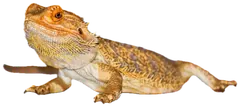
Bearded dragon: lifespan, size, diet and care
Without UVB it gets sick: the tube goes inside the terrarium, because glass blocks UVB.
Take the quiz: is it right for you?
How big it is
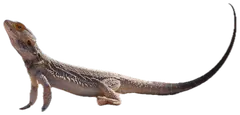
An adult is up to 61 cm (24 in) long.
Zoomed ×2: here you see the man up to 95 cm (37 in) off the ground


Before it arrives
- A vivarium at least 120 × 60 × 60 cm (48 × 24 × 24 in; long, high, wide) for one adult, ventilated and secure
- A guarded heat lamp with a thermostat: basking spot at 38–42 °C (100–108 °F), cool end at 22–26 °C (72–79 °F), and two thermometers
- A high-output UVB tube (10–12%) up to half the vivarium's length, fitted inside (glass blocks UVB), and a 12-hour timer
- A heater that gives no light for the night, if the room drops below 20–22 °C (68–72 °F)
- A hide at each end, plus rocks and sturdy branches to climb
- A safe floor: rough tiles or slate, or reptile carpet (paper towels for babies); no gravel, corncob or cat litter
- A large shallow water dish, live insects, leafy greens and calcium powder
- Set up and run the vivarium for at least a week before it arrives
Its home: temperature and light
- Basking spot
- 38–42 °C (100–108 °F)
- Cool side
- 22–26 °C (72–79 °F)
- At night
- 20–22 °C (68–72 °F)
- Humidity
- 30–40%
- Light
- 12 hours a day
- UVB lamp
- needed
What it eats and how often
insects no bigger than its mouth, plus greens; adults about 60% greens. In the morning
- Babies: every day, 2–3 meals a day
- Juveniles: every day, 1 meal a day
- Adults: every day, 1 meal a day
In the morning. When young, about 65% insects and 35% greens; when grown (over 30 cm, about 12 in), about 40% insects and 60% greens. Insects no bigger than its mouth, that is, no longer than the space between its eyes; for adults 3–4 times a week. Mixed leafy greens (dandelion, arugula, watercress), very little fruit, no spinach. Remove leftovers every day.
Vaccines and checkups
None: reptiles don't need vaccines.
A checkup at the vet every year. With a reptile vet.
The care calendar
What to do, from the most frequent to the least.
- every dayGreens and insectsFresh greens every day, in the morning; dusted insects: twice a day for babies, 3–4 times a week for adults.
- every dayFresh waterA large, shallow dish of clean water, changed every day: it drinks little, but needs it there.
- every weekMultivitamin on the foodCalcium on the insects every day, the multivitamin once a week.
- every monthFull clean of the terrariumRemove droppings as you see them.
- every 6 monthsUVB lampIt still gives light after the UVB has run out: replace it when the brand says (fluorescent tubes usually every 6 months).
- every yearYearly check-upWith a reptile vet.
Call the vet right away if…
If you see one of these signs, call your vet now: don’t wait for it to pass.
- Twitching, swollen legs or face, or trouble walking or climbing
- Loses weight, even during brumation
- Poor appetite outside of brumation
- Brings up food after eating
- Diarrhea or no droppings, together with weight loss
Frequently asked questions
How long does a bearded dragon live?
Usually 10–15 years.
How big is a bearded dragon?
An adult is up to 61 cm (24 in) long.
How much does a bearded dragon weigh?
An adult usually weighs 283 g (10 oz) to 510 g (1.1 lb).
What does a bearded dragon eat, and how often?
Insects no bigger than its mouth, plus greens; adults about 60% greens. In the morning. In the morning. When young, about 65% insects and 35% greens; when grown (over 30 cm, about 12 in), about 40% insects and 60% greens. Insects no bigger than its mouth, that is, no longer than the space between its eyes; for adults 3–4 times a week. Mixed leafy greens (dandelion, arugula, watercress), very little fruit, no spinach. Remove leftovers every day. Babies: every day, 2–3 meals a day; juveniles: every day, 1 meal a day; adults: every day, 1 meal a day.
Does a bearded dragon need vaccines?
None: reptiles don't need vaccines.
When should a bearded dragon see a vet right away?
Right away if you see one of these signs: twitching, swollen legs or face, or trouble walking or climbing; loses weight, even during brumation; poor appetite outside of brumation. The others are above, in “Call the vet right away if…”.
How old is a bearded dragon in human years?
There’s no serious human-years chart for a bearded dragon: the ones online don’t cite sources. What counts is where it is in its life: its senior years start at about 7.5 to 11.3 years old.
Tools for your bearded dragon
Always ask your vet: this site helps you understand, it doesn’t replace a checkup.
Sources
- RSPCA, Bearded dragon care (checked on September 30, 2026)
- Association of Reptile and Amphibian Veterinarians (ARAV), Bearded Dragons, Companion Reptile Care Series (PDF, copy on a veterinary clinic website) (checked on October 13, 2026)
- Merck Veterinary Manual, Routine Health Care of Reptiles (checked on October 14, 2026)
- Merck Veterinary Manual, Table: Important Husbandry Requirements for Selected Reptiles (checked on October 13, 2026)
- Animal Diversity Web, Pogona vitticeps (checked on October 13, 2026)